Canopy: an automatically managed growth-market liquidity basket
Research update (13 September 2026): all 90 checked current v2 launches have zero core pool fees. Headline pons charges are not automatically income for an outside LP. Fee entitlement is a prerequisite for the proposed vault. Read the historical analysis and evidence.
Status: product proposal · 13 September 2026. All allocation limits, thresholds, fees, and economics below are proposed research parameters, not validated investment recommendations. The existing app provides market data, wallet reads, and paper trades; it does not manage LP positions or customer deposits.
Product thesis
Canopy could manage liquidity across a basket of emerging pons-launched tokens, earning trading fees while automatically controlling inventory, liquidity ranges, and exposure. Users would see where capital is deployed, what fees it earns, what it costs to manage, and whether total capital is growing after losses.
The investable hypothesis is persistent trading demand creates fee income large enough to compensate for adverse selection, token and ETH exposure, and execution costs. Fast price appreciation alone is insufficient. An asset can have excellent momentum and still be a poor market to supply with liquidity.
Interpret “pons coins” as tokens verifiably launched by the pons launchpad, rather than only the PONS token, Pons Bot, or similarly named projects. No particular token is approved by this proposal. Canopy is independent of pons and Robinhood.
Start with one operator-owned account, no leverage, and a small basket. Develop the pooled deposit product only after the strategy and withdrawal mechanism work. The initial product should be described as a managed liquidity strategy with variable returns, with token and ETH risk explicit.
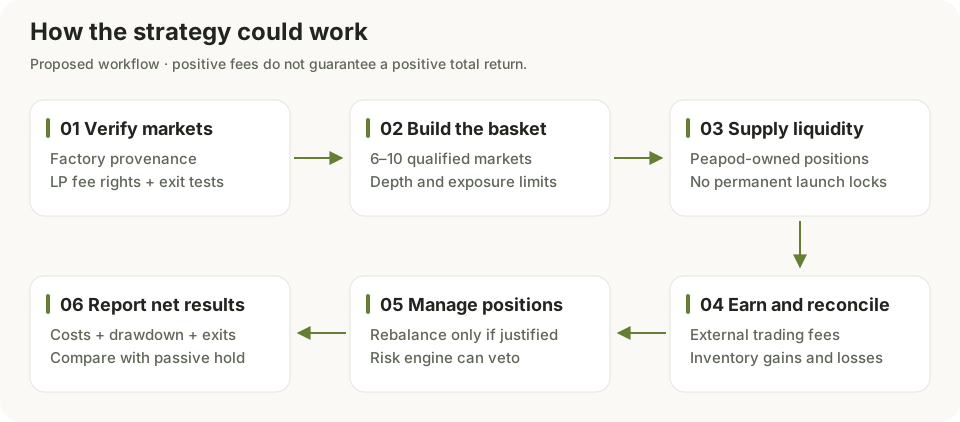
Establish which fees Canopy can earn
The pons v1 documentation describes token/WETH V3 pools and a locked launch position. Graduation is a status change within the same pool. Its stated creator/protocol split concerns the launch position's proceeds; those proceeds do not automatically belong to an outside LP. pons v1 documentation
The project's repository describes v2 as a bonding-curve launch followed by a locked V4 position, with a separate hook and fee distribution system. Treat v1 and v2 as distinct adapters. pons contract repository
The reviewed v2 hook source has separate swap-fee and creator-tax accounting. Its liquidity-add/remove callbacks are disabled in that source, which suggests the hook itself does not reject external liquidity through those callbacks. This is a source-level inference, not proof of deployed compatibility, withdrawability, or positive LP fees. Hook source
Before qualifying a pool, reproduce these steps against a fork of its deployed contracts:
- Verify factory provenance, pool identity, token ordering, bytecode, manager, hook, fee settings, and upgrade/admin permissions at a recorded block.
- Mint a separate Canopy-owned position, execute representative buys and sells, and reconcile exactly which balances accrue to that position.
- Collect fees and withdraw principal completely, including out-of-range and stressed states.
- Attribute core LP fees, protocol deductions, hook charges, creator taxes, and any position-specific claims independently.
- Exclude the pool if Canopy cannot withdraw its own position or cannot earn economically meaningful fees. A tradable token is not sufficient.
Canopy must never deposit redeemable user principal into a permanent launch-liquidity lock. Supplying a separate position does not confer ownership of the launcher's locked position.
If the primary v2 fee stream bypasses outside LPs, alternative venues require evidence of actual routed volume and adequate exit depth. Creating a new pool does not create demand. A negotiated creator-fee agreement is a separate business model with counterparty and enforceability risk; keep it out of the base strategy.
Sources of return and loss
| Component | Treatment |
|---|---|
| Fees earned by Canopy-owned LP positions | Core operating revenue; distinguish accrued tokens from collected and converted proceeds |
| Change in token and quote-asset inventory value | Investment gain or loss, including ETH/USD exposure; separate from fee income |
| LP inventory divergence | Compare against an explicitly defined holding benchmark |
| Incentives or partner payments | Report separately; base viability must survive their removal |
| Gas, execution slippage, swap fees and failed transactions | Operating drag, charged to the strategy |
| Operator fees | Deduct from investor returns and show in dollars |
Concentrated LP positions earn swap fees when their liquidity is active. Moving outside a range changes inventory composition and stops that position participating in swaps until the price returns or liquidity is moved. Uniswap concentrated liquidity
This creates tension with “high growth”: as a coin rises against its quote asset, an LP sells coin exposure; as it falls, the LP accumulates it. A buy-and-hold basket can outperform the LP basket during a strong rally. A diverse basket can still collapse together because launches share traders, liquidity, infrastructure, and market sentiment.
Do not add a speculative hold sleeve to hide LP underperformance. Benchmark an independently managed momentum basket first. Add an explicit hold sleeve only if it improves the agreed objective after costs.
Basket construction
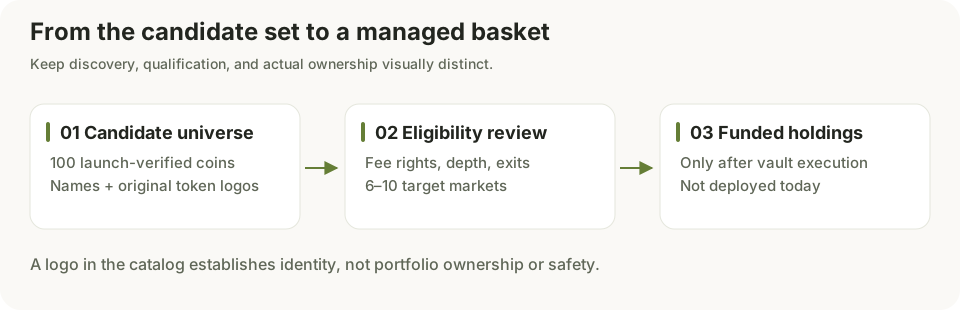
Start the shadow strategy with 6–10 qualified markets, targeting eight. If fewer qualify, retain unallocated capital rather than weakening eligibility.
Eligibility before ranking
| Gate | Proposed initial research setting |
|---|---|
| Provenance | Factory event plus verified token/pool relationships; symbol matching is insufficient |
| Maturity | At least seven days of usable history; completed v2 pool creation; expired launch restrictions |
| Contract behavior | Successful buy, sell, add, collect, and remove simulation; reject unexplained taxes, transfer restrictions, or unknown privileged paths |
| Economics | Demonstrated positive third-party LP fee entitlement |
| Market quality | At least three days of persistent activity; discount suspected wash trading and related-wallet activity |
| Depth | Canopy allocation no more than 2% of external pool TVL, plus a stricter executable-exit test |
| Exit capacity | Estimated unwind over 24 hours at no more than 5% participation in conservative organic volume, with a modeled all-in cost budget |
| Concentration | Review top holders excluding identified pool/lock/burn addresses; flag a related cluster above 20% of circulating supply |
| Price observations | Sufficient observations for price checks and realized volatility; quarantine inconsistent or stale state |
The numbers are deliberately provisional. TVL and wallet counts are weak substitutes for executable liquidity and beneficial ownership. Wash-trade and clustering classifications are uncertain, so store confidence and rerun rankings with harsher discounts.
Rank useful growth
Score eligible markets daily using percentile ranks available at that time:
- 30%: persistence and growth in estimated organic fee-bearing volume.
- 20%: growth in executable two-sided depth.
- 15%: growth in independent active traders, with cluster-adjusted estimates.
- 15%: conservative expected net LP edge after execution and inventory-risk estimates.
- 10%: price momentum that persists across several windows.
- 10%: holder dispersion and improving sell-side resilience.
Use price momentum as supporting evidence, not the dominant objective. Retain failed and delisted launches in the dataset. Use entry/exit hysteresis to avoid constant basket rotation, and cap correlated creator/funder clusters across markets.
Initial allocation and liquidity policy
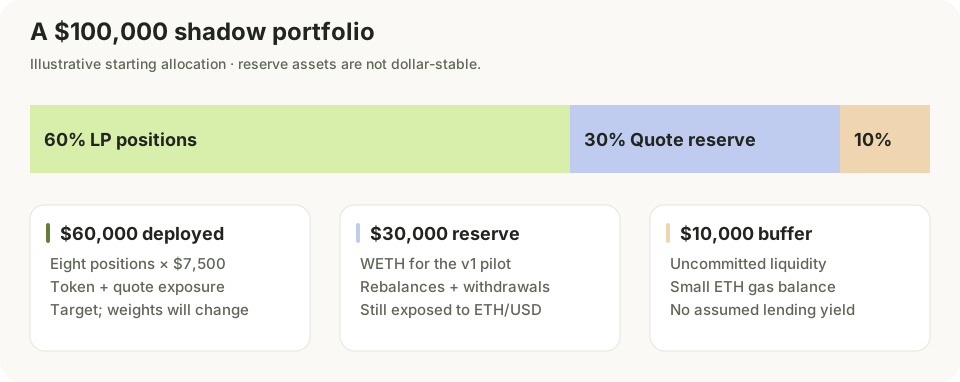
Illustrative allocation for a $100,000 shadow portfolio:
| Sleeve | Allocation | Purpose |
|---|---|---|
| Eight token/quote LP positions | $60,000 total; $7,500 each initially | Earn fees from external order flow |
| Liquid quote reserve | $30,000 | Redemptions, rebalances, and reduced deployment during poor conditions |
| Uncommitted liquidity buffer | $10,000 | Operational flexibility; remains idle until eligible capacity exists |
For a v1-first experiment, use WETH as the accounting and deposit asset, with a small ETH gas balance included in the reserve. Publish USD returns alongside WETH returns. This reserve carries ETH price exposure; it is not a dollar-stable reserve. A later stablecoin vault needs its own quote-conversion, pricing, and withdrawal analysis.
Initial caps: 10% of NAV per LP position, 20% per related ecosystem cluster, no borrowing or perpetual hedges. Count token amounts inside LP positions and idle token balances when calculating inventory exposure. Recalculate weights after price changes; an initial allocation is not a lasting exposure limit.
For each pool, begin with a broad range sized from trailing realized volatility and a 24-hour risk horizon. A starting experiment is a log-price band with half-width max(2 × daily volatility, ln(1.30)), aligned to valid ticks. Use a validated midpoint and reject markets whose uncertainty cannot be accommodated within the risk budget. This band is an experiment to compare with passive full-range liquidity, not an optimal range claim.
Only move liquidity when a persistent range/inventory condition is met and expected incremental fees exceed estimated gas, swap fees, slippage, and adverse-selection cost by a margin. Start with a 30-minute cooldown and a two-times estimated cost hurdle. Check every minute, evaluate risk every five minutes, review membership daily. Emergency risk responses bypass the cooldown, but still obey execution constraints.
A stop condition can remove liquidity and retain the resulting assets. Removing liquidity does not liquidate token exposure. A failed or prohibitively costly sale must be shown as stranded inventory rather than marked as a successful exit.
Measure yield without hiding capital losses
Maintain a balance-sheet ledger using actual token quantities and LP claims, with consistent valuation at each observation. For a period:
strategy P&L = ending NAV − starting NAV − deposits + withdrawals + cash distributions
NAV includes idle balances, LP principal, conservatively valued collectible fees, and liabilities. Fees already included in NAV are not added again. Realized conversion proceeds and unrealized fee-token value are different reporting fields.
Publish:
- Net time-weighted total return in WETH and USD; account for external flows at valuation boundaries.
- Collected fee income, accrued uncollected fees, and realized conversion costs.
- Inventory price P&L, execution costs, operator fees, and maximum drawdown.
- LP excess return against the same initial inventory held passively, and against a passive LP policy with identical capital flows.
- Portfolio return against WETH holding and a separately specified momentum basket.
- Estimated exit value and time, distinct from midpoint NAV.
Impermanent loss is benchmark-relative; do not subtract it a second time from a NAV change that already reflects LP inventory. Likewise, loss-versus-rebalancing is a separate attribution benchmark, not another blanket subtraction. Present annualized fee run rates only with observation period and costs; never label a few hours of gross fees as sustainable APY.
Illustrative unit economics
These inputs are hypothetical and do not imply current pons LP fee rates or achievable market share. Assume $100,000 NAV, $60,000 deployed, a 0.30% fee rate actually payable to LPs, and a 2% swap-weighted share of eligible active liquidity.
daily gross LP fees ≈ eligible external volume × LP-payable fee rate × effective active share
The share is a per-swap approximation to replay, not position capital divided by total pool TVL. Hook charges that accrue elsewhere are excluded. Own rebalancing volume is excluded from revenue projections; its fees are a cost, net of any recoverable self-share.
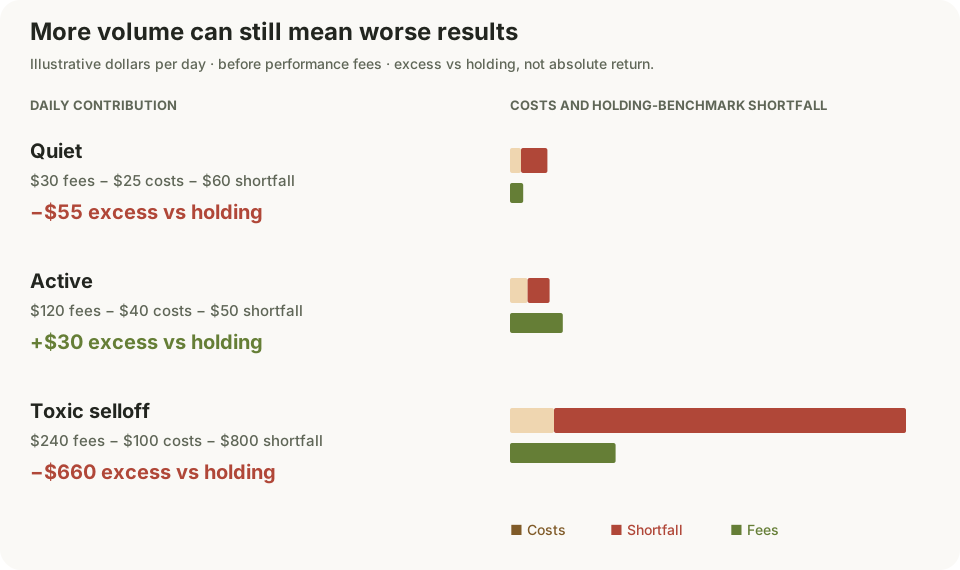
| Daily case | Eligible volume | Gross LP fees | Execution + allocated operations | Inventory drag relative to holding* | Excess after costs* |
|---|---|---|---|---|---|
| Quiet | $500,000 | $30 | $25 | $60 | −$55 |
| Active | $2,000,000 | $120 | $40 | $50 | $30 |
| Toxic selloff | $4,000,000 | $240 | $100 | $800 | −$660 |
\*An assumed shortfall versus holding for illustration, not a second charge to a measured NAV ledger. These excess figures are before Canopy's performance fee and do not specify the holding basket's gain/loss. Even the active case can have negative absolute return.
Under the active-case assumptions, break-even volume for fees to cover $90/day of costs plus relative inventory drag is $90 / (0.003 × 0.02) = $1.5 million/day. Halving effective active share doubles required volume. Deploying more capital dilutes fee share and changes price impact; capacity is endogenous.
EXPLORE THE ASSUMPTIONS
When do the fees cover the costs?
Change a scenario or move the sliders. All inputs are hypothetical; this estimates excess return versus holding, before performance fees.
A positive excess figure can coexist with an absolute loss. Inventory shortfall is a benchmark comparison; do not subtract it again from actual NAV.
See the editable scenarios. Replay is the decision tool; this arithmetic only shows the hurdle.
Product and business model
A proposed customer journey: inspect mandate and track record, select an approved strategy, deposit the specified asset, receive ownership accounting, review allocations and action receipts, request withdrawal, and receive a clear settlement estimate. Show current drawdown and net return as prominently as collected fees.
For the operator-owned pilot, charge no management or performance fee. A later proposal is a 10% performance fee on positive net returns above a per-share high-water mark, after strategy expenses, crystallized quarterly with loss carryforward and subscription/redemption equalization. Denominate the hurdle in the disclosed accounting asset; a WETH gain may coexist with a USD loss. Keep operator revenue projections separate from investor returns. Avoid charging an additional trade fee for rebalances because it rewards turnover.
A pooled version requires reviewed valuation, share issuance, fee accounting, liquidity queues, and applicable launch/distribution requirements. Do not promise instant redemption while assets sit in volatile LP positions. See the execution specification for the staged path.
Decision
Build an auditable shadow LP manager first. Proceed to small operator capital only if external LP fee entitlement is proven and out-of-sample results beat appropriate passive policies after costs with acceptable drawdown. If high-growth selection adds no durable LP edge, narrow the universe or offer transparent basket execution instead of calling the result yield.