One month of Robinhood Chain: what would LPing have earned?
Research window: 13 August–12 September 2026 inclusive, UTC. This uses 31 completed calendar days, ending at 00:00 UTC on 13 September. Scope is Robinhood Chain DeFi, especially pons-launched tokens, rather than Robinhood brokerage trading or HOOD stock.
The decision that matters first
The current pons v2 pools we checked are not an ordinary swap-fee opportunity for an outside LP. All 90 v2 entries in Canopy's current 100-token candidate set returned an existing launch record with a zero core pool fee. The read was made at one recorded current block; it is not a month-long history of fee settings.
The published v2 factory source rejects a nonzero core pool fee. Its separate hook distributes trading charges through creator/protocol/buyback accounting. An outside LP does not acquire those revenue rights just by adding liquidity. The combination of the deployed records and the source is strong evidence against assuming that headline pons fees become Canopy LP income. We have not completed a deployed-bytecode audit or a mint/collect/withdraw fork test. Factory source, hook source
For the older v1 pools with a complete price history, passive full-range LP exposure beat the concentrated LP policies tested before fees and costs. Holding the same initial 50/50 token/WETH inventory did better still. This is a retrospective inventory comparison on a small survivor sample, not proof of the most profitable executable strategy or an estimate of net LP yield.
The practical direction is to test actual fee-paying venues and secure the fee entitlement first. An agent cannot optimize its way into a fee stream that its positions do not own.
What data was gathered
| Dataset | Retrieved coverage | What it establishes |
|---|---|---|
| DeFiLlama chain TVL | 31 daily observations | Chain-level capital trend |
| DeFiLlama chain DEX volume | 31 daily observations | Reported aggregate trading activity |
| DeFiLlama pons fees | 31 daily observations | Headline launchpad charges, not Canopy income |
| GeckoTerminal pool candles | 553 daily rows across 18 older pools | Price and volume observations; 17 pools cover the full month |
| Candidate launch fee records | 90 current pons v2 tokens | Current snapshotted core LP fee field is zero in all 90 |
| Archive RPC probes | Two month-boundary blocks, two pool methods each | Public endpoint could not serve required historical contract state |
The planned universe had 253 unique addresses: 163 pre-window v1 launches in today's graduated catalog, plus 90 additional current candidates. The candle provider returned repeated HTTP 429 responses. Collection was stopped; the resumable collector now stops on a rate-limit response. Only 18 markets were retrieved, with 17 eligible for the full-period comparison. This is incomplete market coverage, not a census of Robinhood or all pons launches.
The current catalog omits an unknown number of failed, ungraduated, or delisted launches. Even the older cohort is selected from survivors visible today. The downloaded subset also reflects provider availability, not a random sample. Today's hot candidate ranking must not be used as if it were known on 13 August.
Pool candles are explicitly requested in quote-token units and matched by base-token address. The 17 eligible pools are token/WETH pairs with all 31 dates present and positive OHLC values. Empty intervals can be filled by the provider using the previous close, so a complete candle grid does not establish continuous liquidity or executability. Pool volume was retained but not converted into assumed LP fees. CoinGecko/GeckoTerminal OHLCV documentation
Download the research data and reproducible scripts, including normalized CSVs, raw responses, coverage, and RPC evidence. Source definitions are documented by DeFiLlama.
Chain activity grew, but that is not an LP return
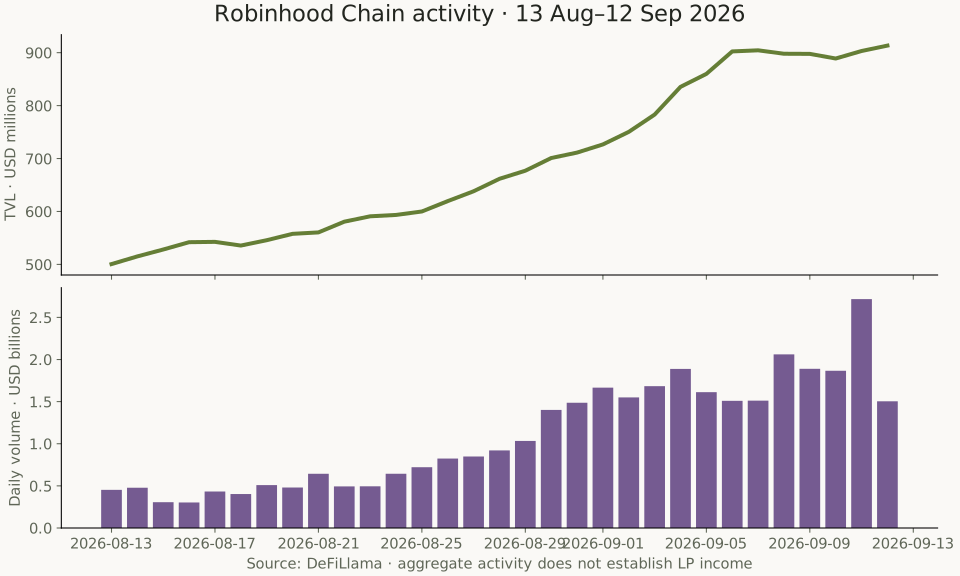
Across the window, reported TVL rose from $500.7 million on 13 August to $913.4 million on 12 September, an 82.4% increase. Reported DEX volume totaled $34.34 billion. Reported pons fees totaled $114.03 million.
These are provider aggregates retrieved for the specified dates. Their calculation methods and coverage may differ: do not divide pons fees by chain DEX volume to infer a pool fee tier. TVL growth also includes asset-price changes and cannot be treated as net deposits. Neither volume nor fees establish organic activity; no wash-trading adjustment was made.
The strategy comparison
Each eligible market starts with one WETH of marked capital at the first day's opening price. Allocate half its initial value to the token and half to WETH. Each market receives the same starting capital, and the aggregate is the equal-weight mean of ending returns; there is no cross-market rebalancing.
All results below are WETH-denominated principal returns. They exclude actual LP fees, gas, entry/exit swaps, price impact, taxes, and management fees except for the explicitly labeled cost sensitivity. They are not USD returns, realized withdrawals, APY, or a trade recommendation.
| Policy | Equal-weight return | Median market return | Positive markets |
|---|---|---|---|
| Hold initial 50/50 token/WETH inventory | +157.82% | +10.55% | 9/17 |
| Passive full-range LP, before fees/costs | +64.18% | +10.04% | 9/17 |
| 60% full-range LP + 40% idle WETH, before fees/costs | +38.51% | +6.03% | 9/17 |
| Static broad range [P₀/2, 2P₀], before fees/costs | −4.99% | +8.83% | 9/17 |
| Static narrow range [P₀/1.25, 1.25P₀], before fees/costs | −13.10% | +5.77% | 9/17 |
| Narrow range recentered at each daily close, before fees/costs | −77.93% | −93.86% | 0/17 |
| Same daily policy, assumed 20 bp NAV cost per reset | −79.26% | −94.23% | 0/17 |
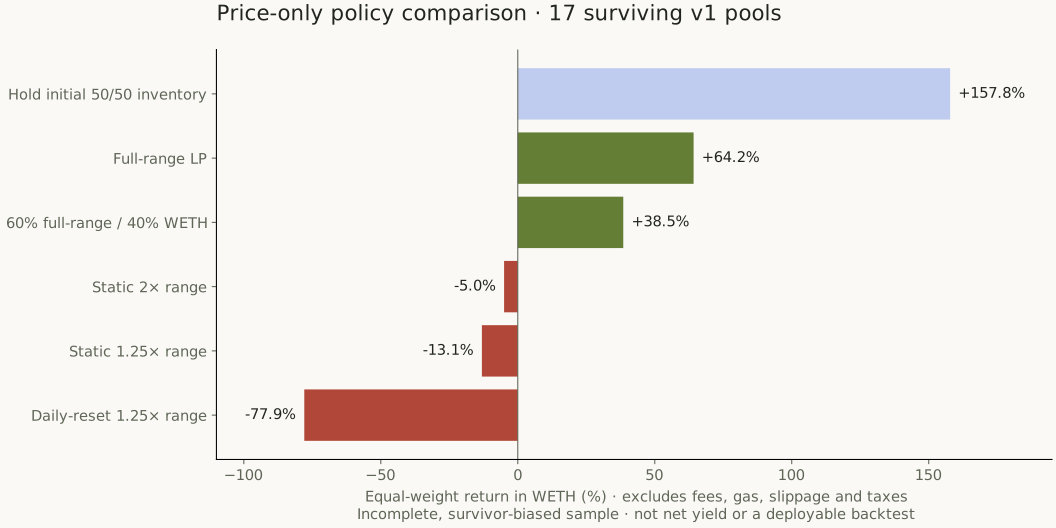
The large gap between mean and median shows that a few extreme winners dominate the aggregate. The daily narrow policy repeatedly realizes changes in inventory and then trades back toward a balanced position. Recentring is not free, and it can repeatedly buy after a rise or sell after a fall. Fees could offset some of that drag on a fee-paying venue, but we did not observe those fees.
As a hurdle, the full-range portfolio needed an additional 93.64% of starting capital in net fees to catch up with the holding benchmark in this particular month. The daily narrow policy needed approximately 142.11% of starting capital in incremental net fees just to match passive full-range principal performance. These are retrospective benchmark gaps, not sustainable yield targets.
Which markets looked best in hindsight?
| Token identity | Full-range principal return | Hold initial 50/50 inventory |
|---|---|---|
| website · 0x0762C1708F0D23F86b29D6B857121FF7DF357506 | +351.41% | +968.87% |
| DELTA | +268.54% | +629.13% |
| SNOP | +226.52% | +483.09% |
| PONS | +208.26% | +425.12% |
| BRODIE | +139.62% | +237.09% |
The normalized CSV contains full token and pool addresses for every row. These are hindsight winners in a biased sample, not a basket we could have selected using only information available at the start. Their high inventory returns do not tell us which pools had the best net fee opportunity.
Model details and limits
Let r = ending token price in WETH / starting token price in WETH. A zero-fee constant-product full-range position has normalized marked value sqrt(r). Holding the same starting inventory has value (1 + r) / 2. This yields the standard divergence comparison, without treating divergence as a second deduction from portfolio NAV.
For a finite range [a, b], with liquidity L and price P, the in-range token balance is L × (1/sqrt(P) − 1/sqrt(b)), and quote balance is L × (sqrt(P) − sqrt(a)). Below the range, the position is all token; above it, all quote. We normalize L so starting value equals one WETH. This is continuous-price math, not a tick-rounded transaction replay. Uniswap amount-delta implementation
The daily policy exits and re-mints at each daily close, carrying its remaining capital forward. The sensitivity applies a hypothetical 20 basis points of NAV to each of 31 daily resets; this is not measured slippage and includes the final reset even though it provides no further earning interval. Results exclude fee compounding. Real quotes, tick spacing, minimum sizes, depth, and adverse execution could change outcomes.
Daily candles cannot show which price path traded through each range, the liquidity competing at those ticks, or how much fee growth belonged to a position. A range can be inside at the close while inactive for much of the day. Archive calls for slot0() and feeGrowthGlobal0X128() at the actual start/end boundary blocks failed with metadata is not found. Swaps, tick changes, liquidity events, fee growth, and historical configuration are still required to rank net LP profitability.
We cannot honestly name the most profitable net LP strategy across Robinhood from this dataset. We can identify the strongest inventory policy among those modeled, quantify the fees needed to change that ordering, and reject the assumption that zero-core-fee v2 pools pay normal outside-LP income.
What it means to LP on one of these markets
To LP a token/WETH market, Canopy would supply token inventory and WETH to a pool so other wallets can exchange one for the other. In a concentrated pool, Canopy chooses the price interval where that inventory is available. It would own a separate position that can be managed and withdrawn, rather than the launchpad's permanently locked launch position.
When buyers demand the token, the position sells token inventory and accumulates WETH. When sellers exit the token, the position accumulates tokens and gives up WETH. Outside the selected interval it becomes one-sided and stops earning ordinary in-range fees until prices return or liquidity moves. Uniswap concentrated liquidity
For intuition, if a token quadruples against WETH, one WETH initially deployed 50/50 becomes two WETH of full-range LP principal before fees. Holding the same starting assets becomes 2.5 WETH. The LP made money in WETH but lagged holding by 0.5 WETH. If the token instead falls 75%, LP principal becomes 0.5 WETH and holding becomes 0.625 WETH. Market making is inventory exposure, not a deposit account.
On a fee-paying venue, fees compensate active liquidity. Core swap fees, protocol deductions, and hook charges are separate streams. The headline amount a trader pays is not necessarily the amount an outside LP receives. Uniswap fee concepts
How pons and Uniswap fit together
pons is a launch mechanism and trading interface. Uniswap supplies the AMM contracts that can support a launched token's secondary market. A pons token is not a Uniswap token, and using Uniswap contracts does not create an endorsement by Uniswap.
The project's published architecture distinguishes v1, which starts in a V3 pool, from v2, which starts on a bonding curve and later creates a V4 pool. The launch position is locked. V2's hook implements additional trade-fee handling. A pre-graduation bonding curve trade is not the same activity as an outside provider adding an LP position to a secondary AMM. pons repository
A useful conceptual split is:
- pons: creates and graduates launches; establishes initial pool and fee arrangements.
- Uniswap contracts: account for liquidity and execute swaps according to pool and hook rules.
- Canopy: could own and manage separate eligible positions on behalf of investors.
- Investors: would own claims on the Canopy vault, not the launchpad's creator fees or locked position.
For zero-core-fee pons v2 venues, alternatives include an independently fee-paying secondary pool with real routed demand, an enforceable creator-fee agreement, or a different token universe. None is automatic, and a new pool without order flow does not solve the problem.
How a tokenized LP system could work
A proposed Canopy vault accepts WETH and issues fungible cPonsLP shares. That is a working name, not an existing token. The vault owns idle assets plus the LP position NFTs or position claims. An executor manages only permitted positions under a published mandate; users own proportional economic claims on the entire vault.
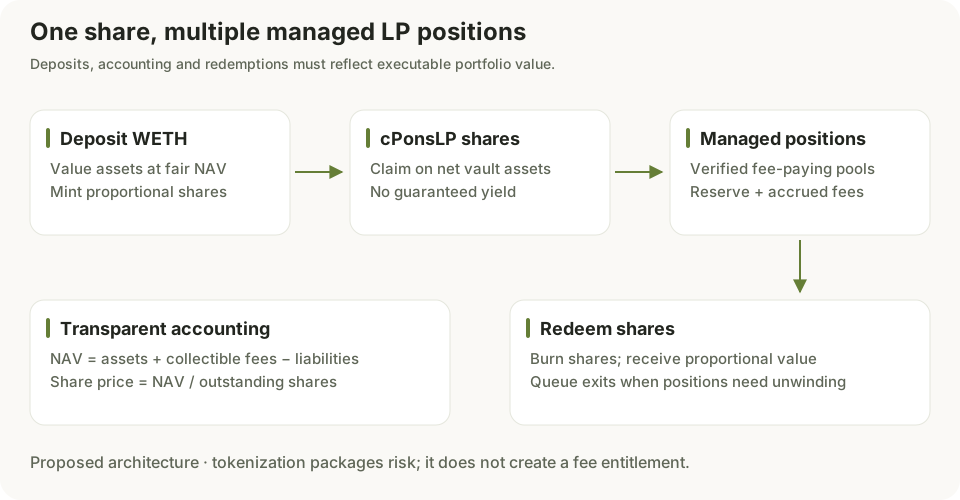
The share token is a receipt for existing vault assets, not a new source of yield. If a vault has 100 WETH of net assets and 100 shares outstanding, a 10 WETH deposit mints 10 shares under a simplified zero-fee, exact-valuation example. NAV becomes 110 WETH with 110 shares. If net assets later rise to 121 WETH, each share is worth 1.1 WETH and those 10 shares claim 11 WETH before exit costs. At 88 WETH NAV, the same 10 shares claim eight WETH. Fees and losses accrue to everyone through NAV per share.
ERC-4626 specifies a standard interface for vault shares and a single underlying ERC-20 accounting asset. A multi-position strategy still needs reliable conversion into that accounting asset; adopting the interface does not solve valuation, risk, or exit liquidity. For queued redemptions, ERC-7540 provides an asynchronous request/claim extension. Final implementation must match the actual settlement model. ERC-4626, ERC-7540
Benefits and tradeoffs
| Benefit | What it offers | What it does not guarantee |
|---|---|---|
| One position for the user | One fungible claim instead of managing many ranges and assets | Protection from correlated token losses |
| Shared operating costs | Batched rebalances, reporting, and fee collection | Profits at any capital size; fee share is diluted as capital grows |
| Automatic management | Consistent position rules and transparent action logs | Superior performance from an agent |
| Common accounting | NAV per share, fees, and return attribution | Accurate NAV without robust pricing and inventory reconciliation |
| Transferability | Potential secondary trading of shares | A liquid market or trading at NAV |
| Composability | Potential integrations with dashboards or other protocols | Automatic lender acceptance or safe leverage |
Redemption should reserve shares, unwind only as liquidity permits, charge clearly disclosed exit costs, and settle against reconciled assets. A secondary market can trade shares at a discount during an exit queue. This is not risk removal. Public deposits require reviewed smart contracts, fee equalization, high-water-mark treatment, oracle/manipulation controls, and applicable distribution requirements.
What Canopy should do next
First, mark zero-core-fee v2 markets as unqualified for ordinary LP-fee revenue in the research process. Preserve them in the visual candidate catalog, but do not imply they are earning assets.
Next, obtain archival state or an indexed trade/liquidity dataset and rerun a point-in-time universe that includes failed launches. Reconstruct actual active-liquidity share and fee entitlement, replay realistic execution, and compare passive full range, broad ranges, threshold rebalances, volatility-based bands, and reserve policies on unseen periods. Pin each policy before its evaluation window; separate strategy selection from test results.
The current evidence favors proving the fee rights and testing broad, low-turnover liquidity first. It does not support launching a vault that promises yield from automatically chasing today's hottest pons coins.